


Marin Water continually dedicates time and resources to preparing for emergencies that could impact our water sources and delivery systems. We conduct comprehensive vulnerability assessments to ensure we’re prepared, no matter the situation.
Our Operations Center is staffed 24/7 year-round, so we are able to activate our Emergency Operations Center (EOC) at any time to coordinate the actions of Marin Water first responders.
Disasters are rarely confined to a particular set of geographical boundaries. We may require the support of outside agencies to handle an emergency that exceeds our resource capabilities. Likewise, other federal, state, or local agencies may request our assistance. When this happens, Marin Water will partner with other agencies to share resources and information and to coordinate the response and recovery effort as a part of the Standardized Emergency Management System (SEMS).
Local Hazard Mitigation Plan
The Marin Water Board of Directors in October 2026 approved an update to the District’s Local Hazard Mitigation Plan (LHMP). This plan is required to maintain eligibility for State and federal hazard mitigation funding programs, and must be submitted every five years to the Federal Emergency Management Agency (FEMA). The purpose of hazard mitigation planning is to assess potential hazards that Marin Water is most vulnerable to and identify strategies to reduce the potential impact to infrastructure, critical facilities, and the services the District provides.
The Disaster Mitigation Act of 2000 (DMA) requires local governments to adopt a federally approved Hazard Mitigation Plan every five years to maintain eligibility for pre- and post-disaster mitigation funds from FEMA’s Hazard Mitigation Grant Program. The DMA emphasizes planning for disasters before they occur.
Review the October 2026 Marin Water Board of Directors resolution and approved Local Hazard Mitigation Plan:
How does the plan benefit the service area?
The Local Hazard Mitigation Plan assists Marin Water with the following:
- Updates the District’s understanding of the local hazards
- Continues to develop sustainable and resilient infrastructure and ability to provide services
- Maintains eligibility for FEMA pre- and post-disaster mitigation funding
- Reduces long-term impacts and damage to infrastructure, critical facilities and services
What is hazard mitigation?
Hazard mitigation is any sustainable action that reduces or eliminates long-term risk to people, property, and services from future disasters.
Phases of emergency management
Emergency Management focuses on reducing or avoiding potential losses from hazards, assuring prompt and appropriate assistance from damages, and achieving rapid and effective recovery measures.
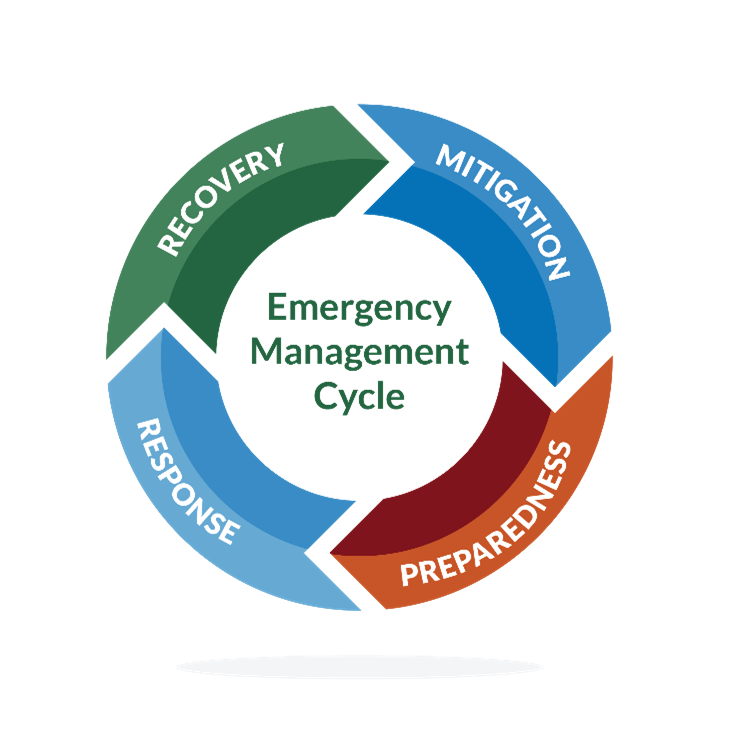
This process is divided into four phases:
- Preparedness – strategies and actions designed to get people and resources prepared and ready to respond to an emergency or disaster
- Response – actions taken to protect life, property and the environment
- Recovery – the process of returning the affected area and people to pre-disaster status
- Mitigation – the methodology of identifying what hazards pose a risk to the area and determining ways to eliminate or minimize those hazards
Related Initiatives
Additional Information
Wildfire Resilience Study
Marin Water’s core mission is explicitly focused on natural resource management, sustainability, and water supply reliability. Implicit in this mission statement is a guiding principle that water reliability is a fundamental element of the community; supporting the economy, ecology, and landscapes that make Marin a unique and desirable place to live.
As the community we serve contends with potential natural disasters, the district recognizes we have a responsibility and role to play; we have a duty to protect the community we serve by preparing for and mitigating the risk of catastrophic wildfire. As climate change continues to impact weather patterns, environmental conditions and fire behavior, Marin Water continues to work to ensure a strong understanding of existing conditions on the watershed, including the watershed’s wildfire resilience, which was most recently detailed in the Wildfire Resilience Study (2021). This study is a living document that presents a comprehensive review of the current state of the District’s wildfire preparedness programs and operations.
PG&E Public Safety Power Shutoffs
Beginning during the 2019 fire season, PG&E began proactively turning off power in designated areas when there is a high risk of a wildfire. PG&E will determine which areas and customers are affected based on several factors, including weather conditions such as Red Flag Warnings, high winds, and dry conditions.
While customers in high fire-threat areas are more likely to be affected, PG&E is asking all of its customers to be prepared, and to plan ahead and have supplies to last for several days, in the event of a Public Safety Power Shutoff (PSPS).
If there is a PSPS event in Marin, Marin Water asks all customers to suspend irrigation and restrict water use to indoors only for the duration of the power shutoff. We rely on electric power to treat and distribute water. By curtailing water use during a shutoff, you can help ensure more water is available for essential uses such as firefighting.
To learn more about how your power supply may be affected by PG&E’s power shutoffs, please visit PG&E’s website at pge.com or call 1.800.743.5000.
To learn more about how Marin Water is preparing for PG&E’s power shutoffs, and what you can do to prepare your home and family, click on the Fact Sheet below.
Download the PG&E Public Safety Power Shutoff Fact Sheet
Water Supplies in an Emergency
Marin Water has invested heavily in facility upgrades and employee training to help ensure our water is there when needed most. There are also some simple steps you can take on your end to be ready in an emergency. (Download this information as a printable brochure in English or Spanish.)
Store an Emergency Supply
One of the easiest yet most essential steps you can take to prepare for an earthquake or other disaster is to set aside an emergency water supply.
- Store at least a three day supply of water for each person in your household. Plan for one gallon per person per day, for drinking and sanitation. Store extra water for pets and family members with special needs.
- Tap water from Marin Water can be safely stored in well-sanitized, food-grade containers such as plastic soda bottles. Avoid used milk or juice jugs and containers that will decompose or break. Seal tightly, then label and store in an easily accessible, dark, cool, dry area away from solvents and chemicals. Replace every six months. You also can purchase commercially bottled or packaged water for long-term storage.
- Don’t forget your other emergency supplies and necessities. Get a complete list at ready.gov.
Know How to Turn Off Your Water
In the event of an earthquake or an unexpected winter freeze, you may need to turn off your water to prevent damage to your property from broken pipes.
- Prepare in advance by locating the water main leading into your house and attach a label to it for quick identification (so that you can find it even in the dark). Turn clockwise to shut off.
- If you can’t turn the water off at the main leading into your house, shut off water at the main meter box (usually by the street), which controls the water flow to the entire property. To shut off, turn valve arrow toward the street.
- If you can’t turn off the water yourself, call Marin Water’s emergency line at 415-945-1500 and we will send someone to turn it off for you.
Identify Other Sources of Water
If a disaster catches you without a stored supply of clean water, you can use the water in your pipes, water heater, and ice cube trays. If you’re not certain about the purity of the water, filter and disinfect as described below.
Consider using water from the toilet tank or perhaps a pool or other outdoor water source for washing and cleaning purposes.
To use the water in your pipes, let air into the plumbing by turning on the faucet in your home at the highest level. A small amount of water will trickle out. Then obtain water from the lowest faucet in the home.
To use the water in your water heater, close the intake valve and cut off the heater’s gas or electricity supply. Open the drain at the bottom of the tank and collect the water in a clean container. You may need to turn on a hot-water faucet in the house to allow air into the tank to start the flow of water. Be sure to refill the tank before turning the gas or electricity back on.